Fallen and uprooted trees
A tree that has come all the way down is sectioned, lifted off whatever it landed on, and hauled away. We work from the top of the load down so weight is released in a controlled way rather than all at once.
Storm-damaged, leaning, or fallen trees in Tamarac, FL. What emergency tree service covers, the warning signs, and how to decide what comes next.
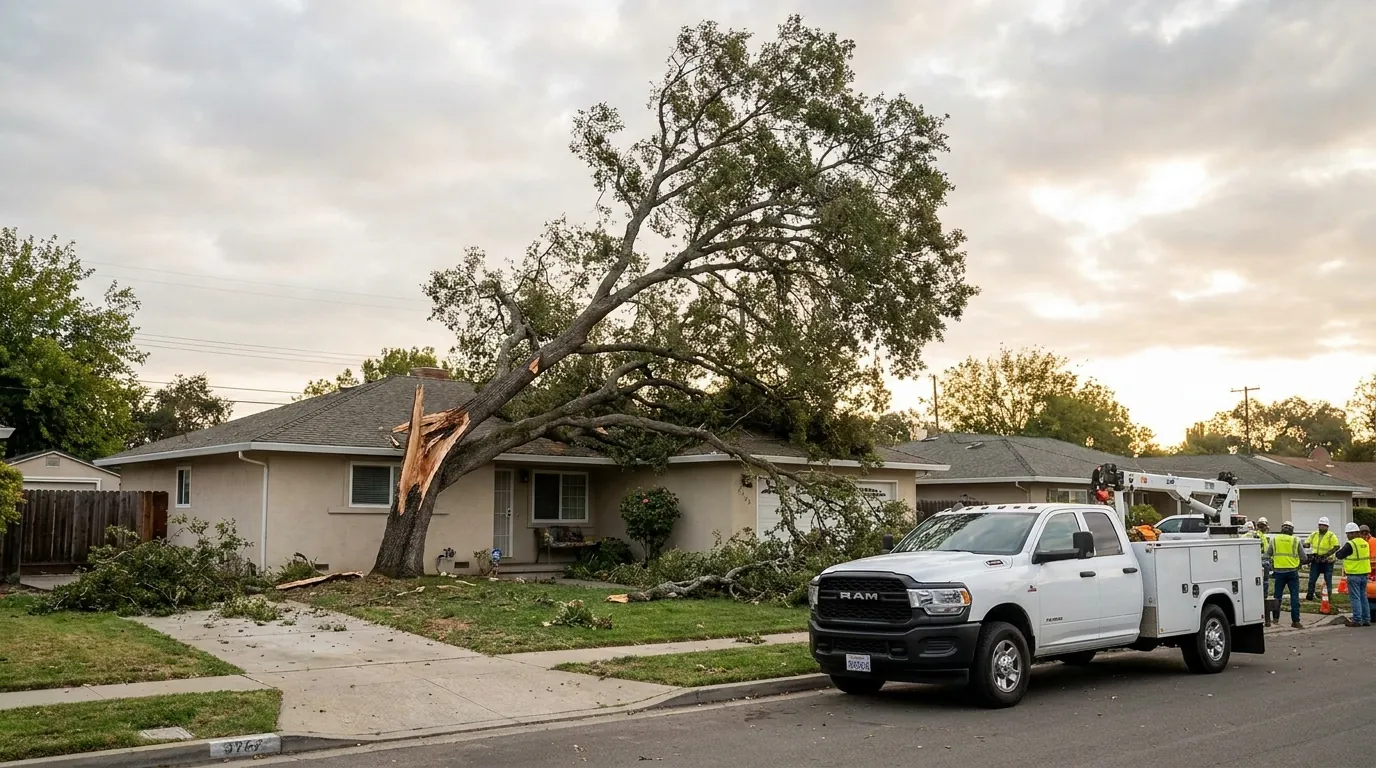
South Florida storms do their worst work in minutes. A squall line or a named storm rolls through Tamarac, and trees that stood for years come down across driveways, roofs, and power lines. Emergency tree service is for the moments when a tree has already failed, or is about to, and waiting until next week is not an option.
Not every fallen limb is an emergency, but some situations are. A trunk that has split, a tree leaning toward a house with fresh soil heaved up at the base, a limb hanging over a walkway, or a canopy resting on a roof all need prompt attention. These are the calls we treat as urgent.
The pattern in Tamarac is specific. High humidity and a high water table keep the soil soft, so when wind loads a tree, the whole root plate can lift rather than the trunk snapping. That is why so many local failures are uprooted trees rather than broken ones, and why a tree that looks fine can be quietly unstable after a wet, windy stretch.
The work ranges from making a scene safe to fully clearing a failed tree.
A tree that has come all the way down is sectioned, lifted off whatever it landed on, and hauled away. We work from the top of the load down so weight is released in a controlled way rather than all at once.
A tree tipping toward a structure with lifted soil at the base is often past saving. We assess whether it can be taken down in place or needs to be roped and lowered in pieces to avoid finishing the damage it started.
Large limbs that have cracked but not fallen — widow-makers — are removed before they drop. These are common after storms and are one of the more dangerous things for a homeowner to leave hanging.
When a canopy is resting on a roof, screen enclosure, or fence, the goal is to remove the load without driving it further into the structure. That means cutting and lifting, not dragging.
Speed matters, but so does doing it in an order that does not make things worse.
First we identify hazards: downed lines, propped loads under tension, and anything overhead that could shift. Nothing is cut until we know which way the weight wants to move.
The piece causing the immediate threat — a limb on a roof, a trunk against a wall — is dealt with before general cleanup. This gets the property out of danger quickly.
Once the urgent hazard is handled, the rest of the tree is cut down, sectioned, and loaded out. On leaning trees we often rope sections down rather than fell them.
Branches, trunk wood, and scattered material are hauled off so you can use the space again. If a stump is left, we can follow up with [stump grinding](/services/stump-grinding/).
Keep people and vehicles away from any leaning tree or hanging limb, and stay far clear of anything touching a power line — assume every downed line is live. If a tree is on your house but the structure feels stable, do not climb on it or try to pull branches off yourself.
If the immediate danger has passed and you are dealing with damage rather than an active hazard, our page on handling storm-damaged trees safely walks through the decisions that come next. For trees that survived but look stressed, a tree health assessment can tell you whether removal is coming anyway.
A tree or large limb that threatens people, a structure, or access — a trunk on a roof, a fresh lean with heaved soil, or a cracked limb hanging over a walkway. If the tree is simply messy but stable, it can usually wait for a scheduled visit.
Yes. Treat every downed or contacted line as live and keep well back. Lines are the utility's responsibility, and tree work around them has to wait until power concerns are cleared.
The high water table and sandy, often saturated soil keep the ground soft. Under wind load the root plate lifts rather than the trunk snapping, so whole trees tip over — especially after heavy rain.
Sometimes, if the lean is slight and long-standing with no soil disturbance. A sudden new lean with lifted soil at the base usually means the roots have failed, and removal is the safer call.
Emergency work focuses on getting the property safe and clearing the debris. The stump can be ground down in a follow-up visit once the urgency has passed.
Call to describe the problem and get a quote for work in Tamarac, FL.