Tree Removal — Cost, Process and Scheduling in Tamarac
Tree removal in Tamarac, FL for dead, leaning, or storm-damaged trees. How the work is done, what drives cost, and how to decide when a tree should come down.
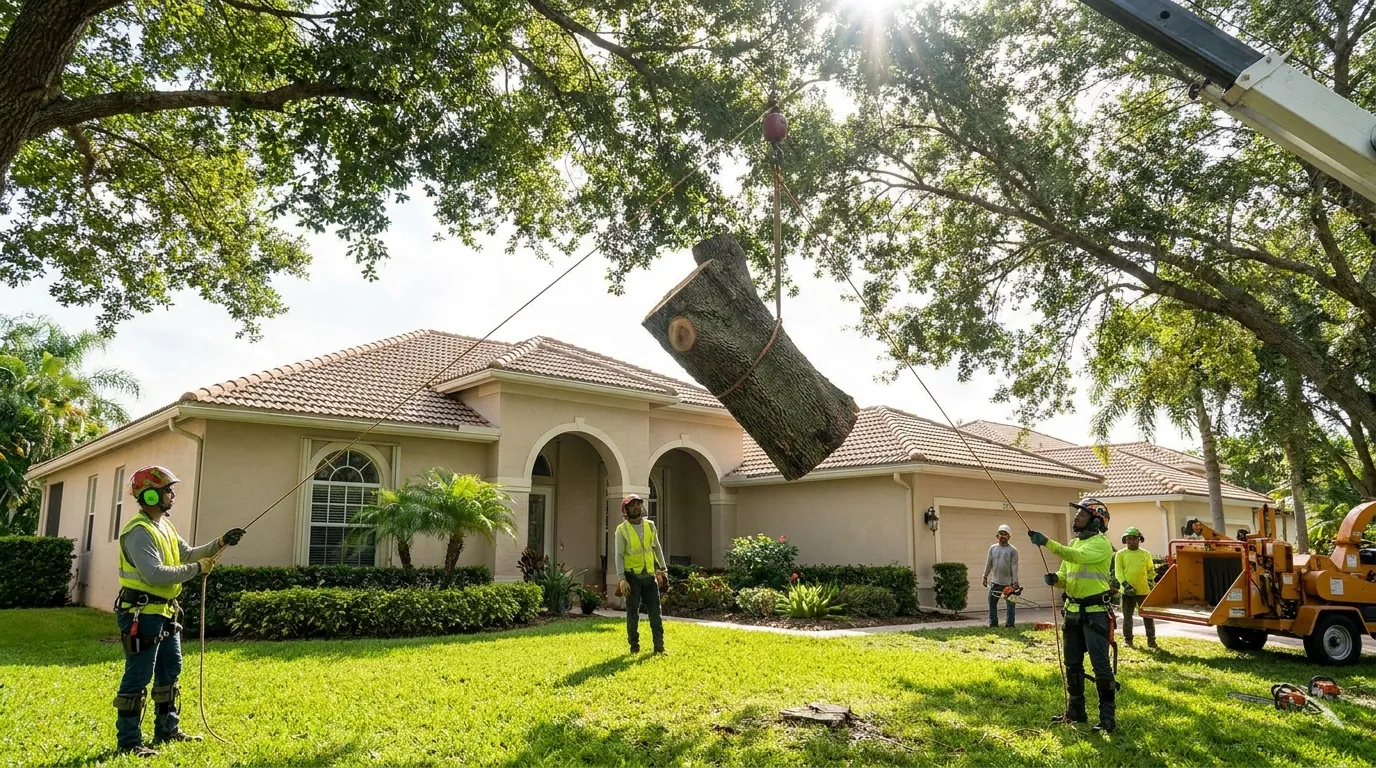
When a tree in Tamarac has to come down
Not every tree that worries a homeowner needs to be removed — but when one does, waiting rarely makes it cheaper or safer. In Tamarac, the trees that most often end up on a removal list are the ones that grow fast in our warm, wet climate and then fail just as fast: laurel oaks shedding heavy limbs, ficus pushing roots under driveways and pool decks, Norfolk Island pines that get top-heavy and catch the wind, and old melaleuca and Brazilian pepper that were never a good fit for the yard. Sandy soil and a high water table mean many of these trees hold on with a shallow, wide root plate rather than a deep anchor, so a tree that looks healthy from the canopy can still tip in saturated ground during a summer storm.
The clearest warning signs are worth knowing before you call anyone. A fresh lean after a storm, soil heaving or cracking on one side of the trunk, large dead limbs in the upper canopy, mushrooms or conks at the base, a hollow or soft spot you can push a screwdriver into, and splits where two main stems meet are all reasons to have the tree looked at. If you are unsure whether removal is the right answer, a tree health assessment can tell you whether the tree can be saved with pruning or cabling instead.
What tree removal actually involves
Removal in a built-up Broward neighborhood is a controlled, piece-by-piece job, not a single cut. Here is how a typical job runs.
-
Assessment and plan
We look at the tree's lean, the condition of the wood, what sits under and around it — fences, screen enclosures, a neighbor's roof, power service — and decide whether it can be felled in one piece or must be taken down in sections. Tight Tamarac lots usually call for sectional removal.
-
Setting up and protecting the area
The work zone is cleared and drop areas identified. On properties with pavers, pool cages, or irrigation, we plan rigging points so limbs are lowered under control rather than dropped onto soft, sandy ground that marks easily.
-
Sectional takedown
A climber or lift removes the canopy in manageable pieces, roping larger limbs down. The trunk is then cut in sections from the top down until only a low stump remains.
-
Cleanup and hauling
Brush is chipped, logs are cut and removed, and the ground is raked. What is left is the stump, which can be ground out separately — see [stump grinding](/services/stump-grinding/).
How Tamarac conditions change the job and the cost
Price on a removal is driven by size, access, and what the tree is sitting next to — not by a flat rate. A tall laurel oak hanging over a screened pool enclosure takes far more rigging and time than the same tree in an open side yard, even though both are 'one tree.' Our high water table matters too: after a wet stretch, saturated soil can make a leaning tree more unstable and raise the urgency, while the same soft ground means heavy equipment has to be kept off certain areas to avoid rutting the lawn.
Species changes the work as well. Ficus and oak produce dense, heavy wood that is slow to cut and haul; palms are lighter but call for different handling. Because Tamarac's storm season concentrates demand, scheduling a non-urgent removal in the drier winter months usually means more flexibility than calling in the middle of a June downpour. If a storm has already done damage and the tree is on a structure or line, that becomes emergency tree service rather than a scheduled removal.
Get a straight answer on your tree
Tell us what the tree is doing and where it sits, and we'll walk you through whether removal is the right call and what the job involves.
Serving Tamarac and nearby Broward communities.
Frequently asked questions
Do I need to remove a tree that's just leaning?
Not always. A long-standing lean with no new movement is often stable, while a lean that appeared after a storm — especially with heaving soil at the base — is a real concern. We look at root condition and soil before recommending removal versus monitoring.
Will removal damage my lawn or pavers?
Tamarac's sandy, often-wet soil marks and ruts easily, so we rig limbs down rather than drop them and keep heavy equipment off soft areas where we can. Some ground disturbance near the trunk is normal, but the work area is raked and cleared when we finish.
What happens to the stump?
Removal leaves a low stump. It can be ground out as a separate step so the spot can be replanted or sodded — most homeowners pair the two. See our stump grinding page for how that works.
How quickly can a dangerous tree be handled?
A tree already on a roof, fence, or power line is treated as emergency work and prioritized. A tree that is declining but not an immediate threat can usually be scheduled, and the drier winter months tend to offer more flexibility.